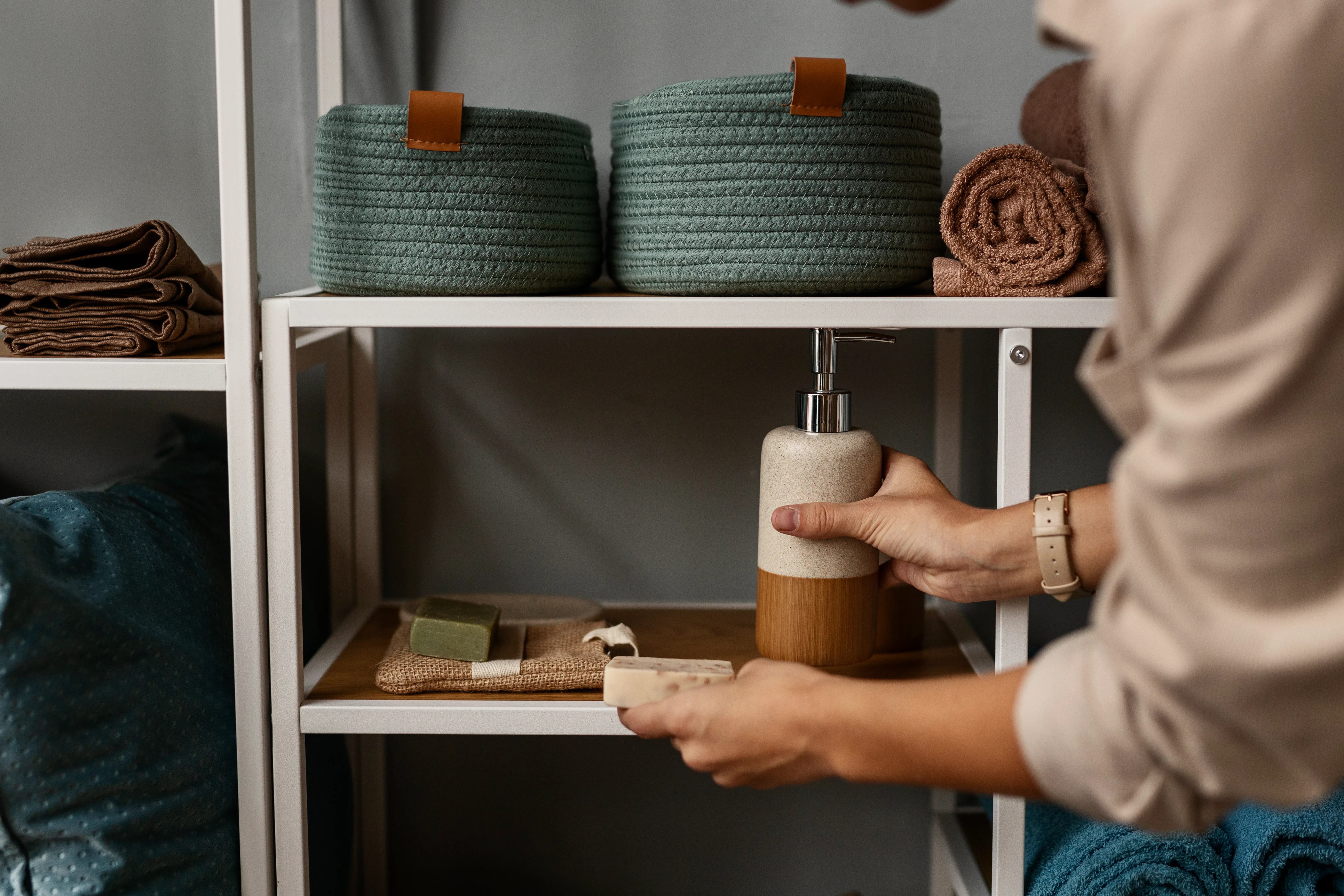
Most of us don't live in homes that look like interiors catalogues, and most of us never will. But that's rarely the goal. What people actually want is a home that feels calm, functional, and easy to manage: somewhere things can be found when needed, surfaces don't pile up, and the Sunday evening tidy doesn't feel like a full-scale operation.
The good news is that an organised home isn't the result of one big declutter. It's built through small, repeatable habits that quietly do most of the work. Here are five that tend to make the biggest difference.
1. Give Everything a Home
The single biggest driver of clutter isn't owning too much stuff. It's owning stuff that has nowhere to go. When an object doesn't have a designated place, it ends up on the nearest flat surface, and flat surfaces quickly become the default storage for everything that hasn't been dealt with yet.
Going through a room and asking "does this have a place?" for each category of object is a more useful exercise than a general tidy. Keys, chargers, paperwork, bags, shoes, and anything else that tends to migrate should have a fixed spot it always returns to. Once that's established, putting things away stops being a decision and becomes a reflex. The habit takes care of itself.
2. Do a Little Every Day Rather Than a Lot Once a Week
The weekly blitz is a tempting idea but it rarely works sustainably. Life gets in the way, the blitz gets postponed, and by the time it happens the job is bigger and more demoralising than it needed to be. A few minutes of tidying each day keeps things from reaching that point in the first place.
A useful approach is to attach small tidying tasks to things you already do. Wipe the kitchen counter while the kettle boils. Put away last night's dishes before making breakfast. Straighten cushions when you leave the sofa. These micro-habits take seconds individually but collectively prevent the gradual drift that makes a home feel out of control. Mind, the mental health charity, notes that our physical environment has a measurable effect on stress and wellbeing, something that anyone who has tidied a room before sitting down to work will already know instinctively.
3. Handle Paper Immediately
Paper is one of the most reliably persistent forms of household clutter. Post, leaflets, receipts, school letters, instruction manuals: it accumulates faster than almost anything else and tends to breed in corners and on kitchen worktops.
The most effective rule is to handle paper once. When a letter arrives, deal with it there and then: file it, act on it, or bin it. A small desktop file with a handful of labelled sections (bills, insurance, to action, keep) takes five minutes to set up and removes the need for any paper to sit in a pile waiting to be sorted. For documents worth keeping long term, scanning and storing digitally reduces physical volume significantly and makes retrieval far easier.
4. Declutter Little and Often
The idea of decluttering tends to conjure images of a full weekend emptying every cupboard onto the bedroom floor. That approach works for some people, but for most it's too daunting to start and too exhausting to finish. A more realistic method is to declutter in small, regular passes rather than one enormous effort.
Keeping a box or bag in a convenient spot for items to donate or sell means the process becomes continuous rather than occasional. When something no longer fits, gets replaced, or simply stops being used, it goes straight in the box rather than back in the drawer. The NHS has written about the psychological benefits of decluttering, linking a more ordered environment to reduced anxiety and improved focus, a useful reminder that tidying up is rarely just about aesthetics.
5. Reset Before Bed
One of the most consistently recommended habits among people who manage organised homes is a short reset at the end of each day. Ten minutes before bed to return things to their places, clear worktops, and set the kitchen straight means waking up to a calm environment rather than yesterday's unfinished business.
The psychological effect of this is larger than the time it takes. Starting the day in a tidy space tends to set a different tone than navigating yesterday's clutter before the first coffee. It also makes the daily tidying habit far easier to maintain, since you're never starting from a significant deficit. The Guardian's guide to home organisation touches on this idea of the evening reset as one of the most practical tools for maintaining a sense of order over time, and it's a habit that comes up repeatedly in conversations about what actually works in real homes rather than staged ones.
Final Thought
None of these habits requires a personality overhaul or a minimalist conversion. They're small shifts in routine that, once embedded, run mostly on autopilot. The homes that feel genuinely calm and organised are rarely the ones that were overhauled in a single weekend. They're the ones where a handful of quiet habits have been doing their work, day after day, without much fanfare.
This article shares general secondhand advice on everyday habits and home management. What works best will always depend on the individual household.